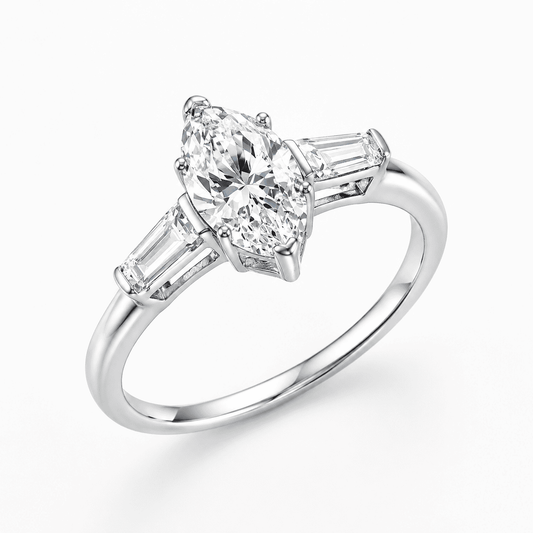
Moissanite Care
What Is a Moissanite Oil Slick?
A moissanite oil slick is a thin surface film that can look blue, brown, or rainbow-like under certain light. It is not oil trapped inside the stone, and it does not mean your moissanite has permanently changed color.

The short answer: A moissanite oil slick is a removable organic film on the gemstone's surface. Start with lukewarm water, mild dish soap, and a very soft brush. If the colored sheen remains, do not escalate to random chemicals or abrasive polishing. Protect the metal and setting by following the jewelry maker's care instructions or asking a qualified jeweler to clean the stone.
What exactly is a moissanite oil slick?
The name sounds dramatic, but an oil slick is simply a surface phenomenon. It is a very thin film that interferes with the way light enters and leaves the stone. Because the layer is so thin, reflected wavelengths can separate into blue, brown, purple, or rainbow-like patches. The effect may be obvious under a phone flashlight or spotlight and nearly invisible in diffused daylight.
Moissanite manufacturer Charles & Colvard describes this as an organic film buildup that can resemble an oil slick on top of the gemstone. Importantly, the company notes that the film is not permanent. That distinction matters: an oil slick sits on the surface and can be removed, while an inclusion, chip, or feature beneath the surface will not wipe away.
The sheen should also not be confused with moissanite's natural fire. Moissanite disperses white light into spectral colors strongly, so clean stones can flash vivid colors as they move. GIA explains that moissanite has more than twice the fire of diamond. Natural fire moves rapidly across facets; an oil-slick patch tends to remain in one area of the stone as the ring changes angle.
How can you tell if it is really an oil slick?
Simple inspection: Clean the ring gently, dry it completely, and look at the stone in diffused daylight and under one directional light. Rotate the ring slowly. Moving rainbow flashes are usually normal fire; a stationary colored patch is more consistent with surface film.
Why does an oil slick develop?
Daily life places many invisible materials on a ring. Skin oils, moisturizer, sunscreen, makeup, hair products, soap, cooking residue, and cleaning products can combine into a film. Repeated contact followed by incomplete rinsing may allow residue to build layer by layer. Minerals in hard water can add another deposit and make the surface harder to clean with a dry cloth alone.
The underside of a center stone deserves attention too. Open galleries allow light into the pavilion, but they also expose it to lotion and soap. When residue collects underneath, the entire stone may look flatter or grayer. That is ordinary buildup rather than necessarily an oil slick, yet the two conditions can occur together.
An oil slick is not proof of low-quality moissanite. It can appear on a durable, well-cut stone because surface contamination is separate from cut, clarity, and color grade. For a broader explanation of those characteristics, see Dreamall's Moissanite Quality Guide.
How to remove a moissanite oil slick safely

Inspect the entire ring first
Check the center stone, prongs, accent stones, and band. If a stone moves, a prong catches, or the ring has recently taken a hard impact, stop and arrange a professional inspection before cleaning.
Wash away ordinary buildup
Mix lukewarm water with a few drops of mild dish soap. GIA recommends warm water, mild soap, and a soft brush for many gems. Soak the ring briefly, then brush the stone gently from the top, sides, and underside.
Rinse in a separate bowl
Use clean water in a bowl rather than rinsing directly over an open drain. Remove all soap, because leftover cleaner can create another film when it dries.
Dry before judging the result
Pat the ring with a clean lint-free cloth and allow moisture around the setting to air-dry. Water droplets and fibers can imitate spots, so wait until the piece is completely dry before inspecting it.
Escalate cautiously if color remains
A persistent oil slick may require a product or polishing cloth intended specifically for the gemstone. Charles & Colvard warns that its special cloth should touch the stone only because it can affect rhodium plating. Follow the maker's instructions exactly, or let a jeweler handle the treatment.
Request professional help when uncertain
If the patch does not improve, if you cannot isolate the stone from the metal, or if the piece contains plated metal or delicate accent gems, professional cleaning is the safer next step.
For routine cleaning between deeper treatments, use the steps in Dreamall's Jewelry Care Guide.
What should you not use on an oil slick?
| Avoid | Why |
|---|---|
| Toothpaste or abrasive powder | Moissanite is hard, but abrasives can scratch or dull the metal and plating around it. |
| Bleach or chlorine | GIA warns that chlorine bleach can pit or damage gold alloys. |
| Unidentified acidic mixtures | A method that changes surface film may also attack solder, plating, accent stones, or other parts of the ring. |
| Metal picks or sharp tools | They can scratch the setting, catch a prong, or create pressure near the stone. |
| Abrasive cloth over the whole ring | A stone-specific cloth may strip rhodium or alter a plated finish when rubbed on the metal. |
| Automatic ultrasonic cleaning | Vibration can loosen vulnerable settings, and not every accent gemstone or treatment is ultrasonic-safe. |
Protect the whole piece, not only the moissanite. A center stone may tolerate a cleaning method that its white-gold plating, sterling-silver finish, solder, pavé, or accent gemstones do not. The safest choice depends on every material in the ring.
How to reduce future oil-slick buildup
Put your ring on after lotion, sunscreen, perfume, and styling products have dried. Remove it before washing dishes, using household cleaners, swimming, gardening, cooking with oils, or applying heavy skincare. These habits reduce both residue and unnecessary stress on the setting.
Give the ring a gentle wash when sparkle begins to fade instead of waiting for several layers of residue to accumulate. Rinse thoroughly and dry completely. Store it in a clean, lined compartment rather than beside cosmetics or loose jewelry.
Regular inspection matters as much as cleaning. Look for a loose prong, movement, or an abrupt visual change after impact. Moissanite is durable, but the ring is a system made from stone, metal, and setting. Dreamall's guide to wearing moissanite every day explains when routine removal helps protect the complete piece.
Frequently asked questions
Is a moissanite oil slick permanent?
No. A true oil slick is a surface film, not an internal color change. It should be removable with an appropriate cleaning method, although a stubborn film may require professional attention.
Does an oil slick mean my moissanite is fake or low quality?
No. Surface buildup is not a grading characteristic and does not by itself indicate poor cut, color, or clarity. It reflects what has accumulated on the stone during wear.
Can dish soap remove an oil slick?
Mild dish soap can remove ordinary oil and may improve a light film, so it is the sensible first step. A persistent iridescent layer may need a stone-specific method, but random stronger chemicals are not automatically safer or more effective.
Can I use a silver polishing cloth?
A metal-polishing cloth is designed for metal, not necessarily for removing film from a gemstone. A stone-specific cloth may also be unsafe on plated metal. Use each product only on the material named in its instructions.
Why does the rainbow patch appear only in some lighting?
Thin-film reflections depend on light direction and viewing angle. Check a clean, dry stone in several lighting conditions before deciding that a patch has disappeared or that the stone itself has changed.
When should I take the ring to a jeweler?
Seek help when gentle washing does not change the patch, when the mark seems internal, when the stone or a prong moves, or when you are unsure whether the metal, plating, or accent stones can tolerate the next cleaning step.
Keep the sparkle, skip the harsh treatment
An oil slick is usually a removable surface issue. Begin gently, protect every material in the ring, and ask a professional before using a stronger method.
Sources and editorial note: This guide draws on Charles & Colvard's moissanite-care guidance, the GIA overview of moissanite's optical properties, and GIA's general jewelry-care recommendations.
Cleaning requirements vary with metal, plating, solder, setting, accent gems, treatments, and condition. When in doubt, consult a qualified jeweler before using specialized products or equipment.